

High on Life 2 is the kind of game that knows exactly what it wants to be and refuses to compromise. It’s loud, weird, crude, self-aware, and unapologetically chaotic. If you enjoyed the personality of the first game, there’s a good chance you’ll feel right at home here. For me, what stands out most is that the humour hasn’t lost its edge. If anything, it feels more confident this time around.
The writing is easily the game’s strongest asset. The jokes are frequent, sometimes ridiculous, sometimes outright stupid in the best way possible. It doesn’t try to be subtle. It commits fully to its absurdity.
The talking guns are once again the backbone of the experience. Their constant commentary never feels like background noise. They react to your decisions. They get annoyed if you ignore them. They feel conversational rather than scripted. That illusion of spontaneity is rare in narrative-heavy games, where dialogue can often feel mechanical. Here, it feels alive.
That constant back-and-forth gives the game momentum even during quieter moments. It’s hard to think of many shooters where simply switching weapons can spark another joke or mini interaction that feels natural.
A World That Embraces Its Own Absurdity
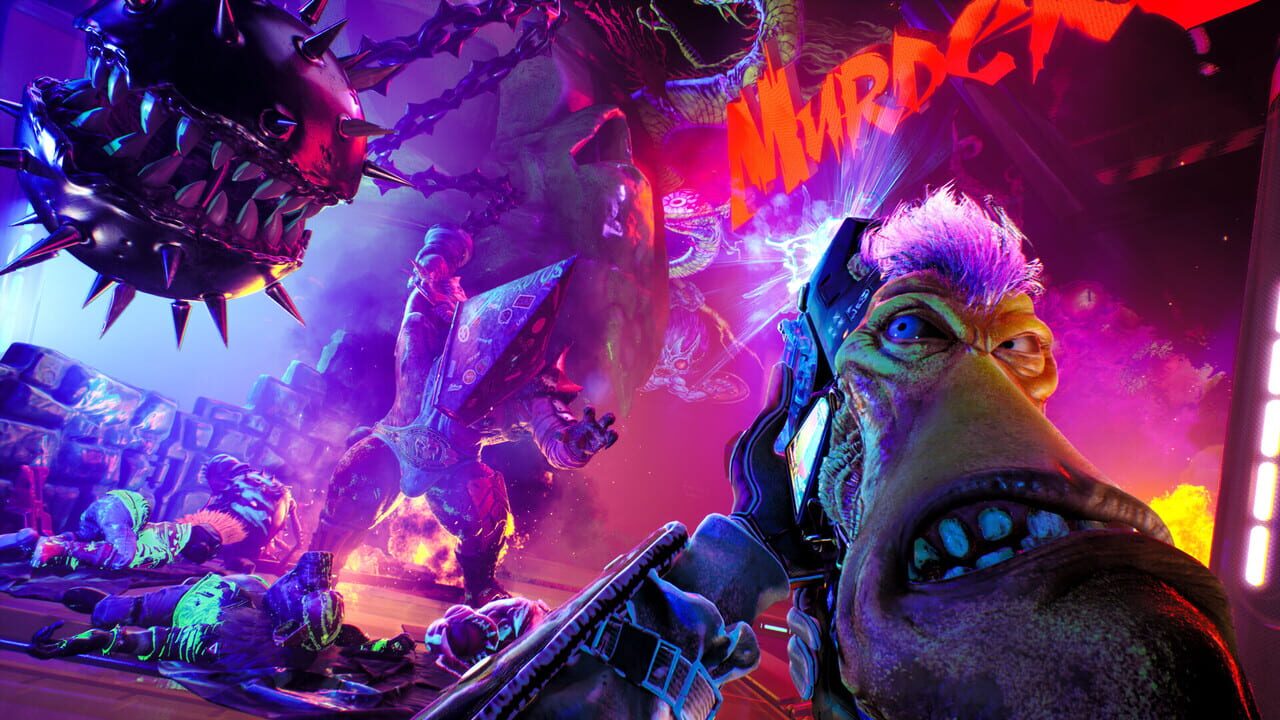
Visually, the game is strong and full of personality. The environments are colourful and packed with strange details. Alien cities feel busy and bizarre. Background props and world-building elements constantly reinforce the ridiculous tone.
There are occasional lighting inconsistencies and moments where textures blur more than they should, but overall the art direction does heavy lifting. The futuristic aesthetic leans fully into nonsense, and that commitment makes exploration consistently entertaining. Even when you’re not fighting, the world is interesting to look at.
The Skateboard!!!
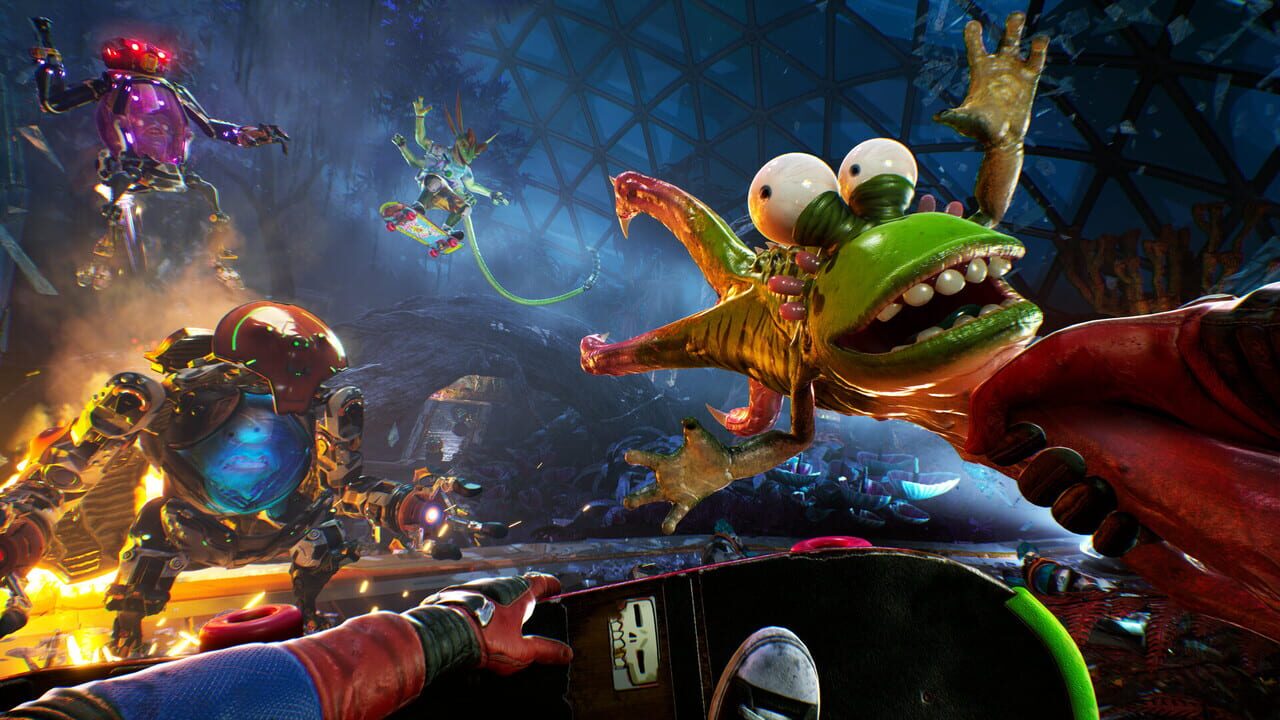
The most surprising mechanical success in the game is the skateboard. It could have been awkward. Movement-based mechanics in shooters often feel like separate modes that disrupt pacing. Instead, it integrates seamlessly. You never feel like you’re switching systems. It just feels like an extension of your movement.
Grinding rails and building momentum feels smooth and intuitive. There’s no clunky transition or frustrating precision barrier. It enhances traversal without complicating it, and that’s impressive.
Combat is where the game becomes more uneven. It works, but it rarely feels exceptional. Reload times can feel slightly too frequent. Some weapons lack the punch you might expect. Special abilities are sometimes underwhelming enough that you forget to use them.
The gunplay doesn’t collapse under its own weight, but it doesn’t elevate the experience either. In a game bursting with personality, the shooting occasionally feels like the least interesting part. It’s serviceable, just not standout.
When Systems Start to Strain
The technical issues are harder to ignore. Most of the bugs I encountered weren’t catastrophic. But their frequency created a subtle, lingering issue. In a game built around environmental interaction and trigger-based sequences, you need to trust that when something doesn’t make sense, you’ve missed a step. Instead, I often found myself wondering whether something had failed to trigger properly.
That doubt changes how you approach the game. You hesitate. You second-guess puzzles. You start troubleshooting rather than experimenting. Even when something isn’t broken, the suspicion lingers.It’s not just about glitches. It’s about confidence in the systems.
The soundtrack is where my experience took the biggest hit. On paper, the musical direction makes sense. It leans into retro-futuristic sci-fi ambience. Mellow synth textures. Layered atmospheric tones. During exploration, it can work well enough to create mood. But the repetition becomes hard to ignore.
Certain melodies loop endlessly. Instead of evolving or escalating, they circle back on themselves until they start to feel intrusive. Not catchy. Not dynamic. Just repetitive.
Some of the ambient tracks honestly feel like they belong in a game such as Astroneer, where subdued background music enhances calm exploration. In that context, it works perfectly.
But High on Life 2 isn’t built around quiet, reflective wandering. It’s supposed to be chaotic and energetic. When you’re in the middle of an intense firefight and a low-tempo ambient loop is playing underneath, the momentum drains. The music doesn’t amplify the action. It flattens it.
Over time, the looping melodies become more than just background noise. They start to stick in your head in an irritating way. Combined with combat that already lacks punch, the under-energised soundtrack ends up dampening the overall intensity of the experience.
For me, this was the most consistently disappointing part of the game. Not because the compositions are inherently bad, but because they don’t match the pacing and tone the gameplay demands.


